How can manufacturers use 5-axis CNC to cut operating costs by 35% and speed up delivery

Introduction
In an increasingly competitive global marketplace for manufacturing, corporations are being challenged to overcome the dual problem of ever-increasing product complexity and the inefficiencies of a multi-step process. The traditional approach to manufacturing—utilizing multiple machine tools, re-configuring fixtures, and managing inter-supplier coordination—results in ever-increasing costs, compromised quality, and ultimately an unbearably slow pace to market. The problem lies in the very process of a decentralized workflow.
This article will attempt to go deeper into an understanding of how 5 axis CNC machining services operates not just as an advanced technology solution, but as an Industrial Business Solutions vehicle to Manufacturing Process Optimization. The answers to the following five key questions will provide a roadmap to lowering costs and improving efficiency.
Why is 5-Axis CNC Machining the Cornerstone of Modern “Precision Manufacturing Services,” Not Just an Advanced Machine?
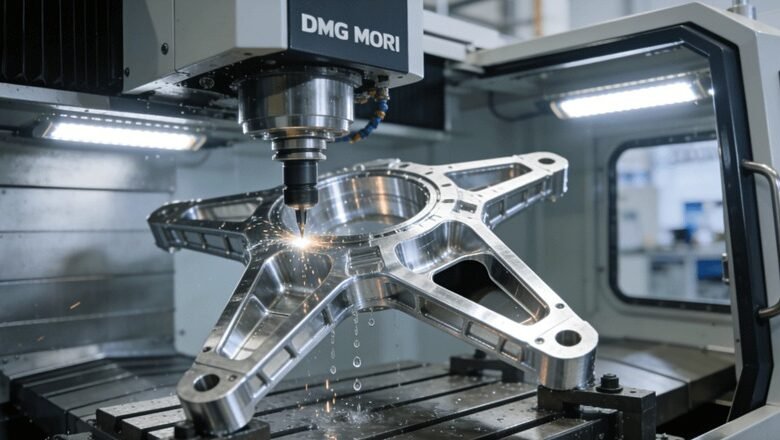
- axis CNC technology is redefining the very concept of “manufacturing,” transforming it from a series of discrete steps into a continuous, data-driven value stream. Its paramount capability lies in completing complex geometries in a single setup. This eliminates the error stack-up that occurs when a part moves between multiple machines and fixtures, making it the critical enabler for faithfully realizing design intent. As noted in reports on digital thread and integrated manufacturing, this technology is foundational for creating a seamless quality loop from design to finished part.
Therefore, true Precision Manufacturing Services built around 5 axis CNC Machining deliver more than components; they deliver predictable high accuracy, consistency, and traceability. However, to ensure that this technological potential can be leveraged, systematic assurance is a non-negotiable. This highlights the significance of collaborating with a service provider who has robust quality frameworks such as ISO 9001:2015 and industry-specific frameworks such as IATF 16949:2016 (automotive) or AS9100D (aerospace). This is the prerequisite that turns high-end technology into a reliable engine for Manufacturing Process Optimization.
When Selecting 5-Axis CNC Machining Services, How Do You Look Beyond Price to Assess True Total Cost of Ownership (TCO)?
Astute decision-makers evaluate 5-axis CNC machining services not by comparing line-item quotes, but through a comprehensive Total Cost of Ownership (TCO) lens. A genuine Industrial Business Solutions provider will demonstrate value across both visible and often more detrimental hidden costs.
Building a Comprehensive TCO Framework
A realistic TCO calculation must extend beyond the unit price to encompass all direct and indirect costs. This includes direct machining and material expenses, plus the often-overlooked indirect costs for custom fixture design, fabrication, and management. Crucially, it must also account for the added time, logistics, and documentation for inter-process quality inspections, and most importantly, the costs from accumulated errors—including difficult assembly, higher rejection rates, and the immense opportunity cost of delayed market entry.
A Two-Pronged Strategy to Systematically Reduce TCO
The key to systemic TCO reduction lies in partnering with a provider that offers seamless, integrated services from design to delivery, transforming a transactional cost into a strategic Industrial Business Solutions investment.
- Strategic Supplier Selection
Choosing a partner with deep expertise in 5-axis CNC machining services and full-process capabilities is foundational. This integration eliminates multiple hand-offs, reduces administrative overhead, and ensures single-point accountability, directly attacking the hidden costs in the TCO framework.
- Leveraging DFM for Front-End Optimization
Expert providers utilize proactive design for manufacturability (DFM) analysis to ensure optimal parts design for manufacture. This front-end engineering collaboration, an essential part of expert providers such as JS Precision, helps to identify problems prior to manufacture to avoid waste, machine time, and assembly complexity to keep the cost low.
What Disruptive Industry Application Cases Demonstrate the Strategic Value of 5-Axis CNC?
The Transformative Proof Across Industries
The transformative power of multi axis CNC machining is validated across advanced industries, where it liberates design paradigms and radically simplifies supply chains. These successful Industry Application Cases collectively prove that 5-axis CNC is a strategic technology capable of redefining both product possibilities and logistical frameworks.
Disruptive Applications in Key Sectors
- Aerospace & Medical: Meeting Extreme Standards
In aerospace, utilizing a best 5 axis CNC machine to mill a monolithic engine bracket from solid titanium replaces dozens of parts, achieving weight reduction and inherently meeting the stringent traceability of AS9100D. Similarly, for medical devices, it allows single-step machining of complex, biocompatible implants with flawless finish, eliminating assembly risks and accelerating the path to ISO 13485 certification.
- Consumer Electronics: Integration for Performance
In high-end consumer electronics, this technology allows for the integration of the casing, structural ribs, thermal channels, and slots into a single part. This is the ultimate integration of aesthetics, structure, and thermal design within a material such as aluminum or plastic.
Faced with Numerous 5-Axis CNC Machining Center Manufacturers and Service Providers, What Four Core Dimensions Should Decision-Makers Use to Screen Them?
Four screening factors are suggested: Technical Depth and Compatibility: Does it have the best 5 axis CNC machine and process database to process your industry materials (such as titanium alloy, PEEK)? Quality and Compliance System: ISO 9001 is the basic requirement; industries have AS9100D or IATF 16949. Supply Chain and Delivery Resilience: Capable of controlling the entire process from raw material to post-processing. Collaborative Engineering Capability: Does it have the capability to offer professional DFM (Design for Manufacturability) suggestions to reduce costs? Assess a fully compliant service provider and analyze the 5 axis CNC service capability matrix.
Given the High 5-Axis CNC Machine Price, How is ROI Calculated for In-House Purchase vs. Outsourced Services?
Confronted with the significant investment of a 5-axis CNC machine price, a rational ROI analysis is essential. The hidden costs of in-house ownership are often underestimated: rapid equipment depreciation, salaries for highly skilled programmers and operators, expensive CAM software licenses, ongoing maintenance, and the risk of technological obsolescence.
In contrast, outsourcing to a top-tier Precision Manufacturing Services provider converts high fixed costs into flexible variable costs. A company can access state-of-the-art technology and capacity on demand without the capital burden, freeing resources to focus on core competencies like R&D and marketing. Research on manufacturing outsourcing strategies supports the trend of outsourcing non-core complex manufacturing to strengthen competitiveness.
Thus, for most companies not specializing in component manufacturing, partnering with an expert provider with deep technical accumulation and complete international certifications represents a more agile, financially sound, and risk-resilient pathway for Manufacturing Process Optimization and a potent Industrial Business Solutions.
Conclusion
In summary, therefore, 5-axis CNC machining is not just a “technological upgrade” for a company, but rather a holistic approach to Manufacturing Process Optimization. It not only allows for extreme precision, integration, and a reduction in the supply chain at its source, but actually enables a company to optimize its cost structure and achieve a qualitative leap in its competitiveness in the market. The secret to success, however, lies in working with a partner who has technical knowledge as well as comprehensive certifications from around the world.
Is your next complex component project a persistent cost challenge or a potential breakthrough for efficiency? Obtain a transparent 5-axis CNC machining solution and cost analysis based on your specific design to witness the tangible value it can deliver.
Author Bio
This article was written by a senior consultant with over fifteen years of experience in the precision manufacturing services sector, specializing in the reshaping of global supply chains by advanced manufacturing technologies. The viewpoints are based on the observation and analysis of numerous successful industrial business solutions.
FAQs
Q1: Is 5-axis CNC machining an economical process for low-volume prototyping?
A: It is highly economical. Its biggest advantage is that it completes all complex features in one setup, thereby avoiding the coordination costs of splitting a prototype over multiple machining processes. It is most appropriate for checking the integrity of a design.
Q2: How is intellectual property protected when outsourcing 5-axis CNC services?
A: It is very important to choose a service provider that has strong information security policies (such as ITAR registration) and confidentiality agreements. The usual measures include physically separate design teams, encrypted file transfers, and on-site audits.
Q3: What is the average time from design to delivery of a 5-axis CNC machined part?
A: For online instant-quote service providers, the time to receive a quote and DFM feedback can be expected within 24 hours. The production time depends on the complexity of the part, taking 3-5 days for simple parts and 1-3 weeks for highly complex parts.
Q4: Can a 5-axis CNC machine parts that include internal hidden channels or structures?
A: Yes, this is one of its major advantages. It can machine complex internal features through tool access at specific angles, which would not be possible with a 3-axis machine.
Q5: Apart from metals, which other materials can be considered for machining with a 5-axis CNC?
A: The materials that can be considered for machining with a 5-axis CNC are many, including different grades of plastics, composite materials, and ceramics. The only condition for machining any material with a 5-axis CNC would be optimizing its cutting conditions.