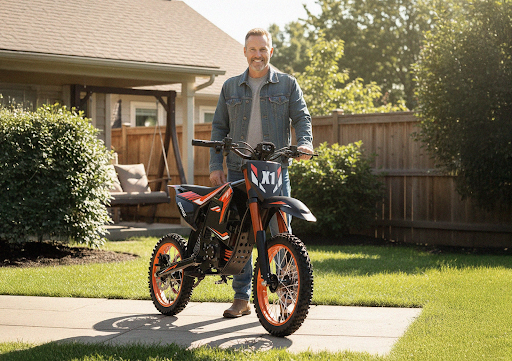
For many families, interest in electric dirt bikes starts with curiosity. Kids see them online, at local tracks, or in their neighborhoods and naturally become interested. Parents, however, tend to see something else first: responsibility.
That’s why the question isn’t simply whether kids can ride an electric dirt bike. A more thoughtful question is whether it is appropriate for a specific child, in a specific environment, with the right level of supervision.
Electric dirt bikes are powered vehicles. Deciding whether they are suitable for kids requires realistic expectations and careful consideration.
Age Is a Starting Point — Not a Guarantee
Age is usually the first factor parents look at. Most electric dirt bikes designed specifically for kids are generally suited for older children and early teenagers — typically around 8 to 15 years old, depending on size and model.
For kids closer to 8 or 9, riding should begin at very low speeds in controlled environments. As kids move into the 10–13 age range, many develop the coordination and judgment needed for structured riding practice. By the early teenage years, some may be physically capable of handling slightly more power, provided supervision remains in place.
That said, age alone doesn’t determine readiness. Two kids of the same age can differ significantly in coordination, attention span, and decision-making ability.
Age provides a framework — it does not replace parental judgment.
Physical and Emotional Readiness Matter Just as Much
Beyond age, physical and emotional readiness are equally important.
Before riding an electric dirt bike, kids should be able to:
- Ride a bicycle confidently without assistance
- Use hand brakes properly and understand stopping distance
- Maintain balance at low speeds
- Follow clear safety instructions
- Stay focused during practice sessions
Emotional maturity also plays a role. Kids who understand boundaries and respond well to supervision tend to adapt more safely to powered riding. Those who struggle with impulse control or distraction may benefit from waiting a bit longer.
Electric dirt bikes require coordination and awareness, but when introduced gradually and under supervision, many older kids are capable of learning responsibly.
Why Electric Dirt Bikes Are Often Considered for Kids
Many parents explore electric dirt bikes because they are generally easier to operate than gas-powered alternatives. When browsing different electric dirt bikes for sale, this ease of use is often one of the main reasons families start considering them in the first place.
Electric dirt bikes typically:
- Deliver smooth and predictable power
- Do not require gear shifting
- Operate more quietly
- Have simpler mechanical systems
The absence of shifting can make early practice more straightforward. Quieter operation may also make communication between parent and child easier during supervised sessions.
This does not eliminate risk, but it can make the learning process more manageable for older kids who are ready to begin structured off-road riding.
Ease of use should be viewed as a supportive feature, not a guarantee of safety.
Understanding the Real Risks
Like any powered activity, riding an electric dirt bike involves risk. However, when matched appropriately to a child’s size and ability, and when used in controlled settings, those risks can be managed.
Common concerns include:
- Loss of balance and falls
- Misjudging speed
- Riding on uneven terrain
- Limited braking awareness in early practice
Most incidents occur when supervision is inconsistent or when riding takes place in unsuitable areas. Starting in open, obstacle-free environments significantly reduces unnecessary hazards.
Electric power does not make a bike harmless, but it also does not make it inherently dangerous when introduced responsibly.
Safety Measures Before Letting Kids Ride
Preparation makes a meaningful difference.
Before allowing kids to ride, parents should ensure:
- A properly fitted helmet is worn at all times
- Gloves and protective pads are used
- Long sleeves and sturdy footwear are standard
- Riding takes place in controlled environments
- Clear rules are established and enforced
Many entry-level electric dirt bikes include adjustable speed settings, allowing parents to begin with lower power modes and gradually increase performance. Some brands, including Qronge, design electric dirt bike models with adjustable power levels that support a step-by-step progression as kids gain confidence.
Even with supportive features, supervision remains essential, especially in the early stages.
Choosing the Right Fit Without Focusing Only on Power
Fit and control matter more than maximum speed.
Seat height should allow kids to place both feet flat on the ground while stopped. Being able to stabilize the bike easily builds confidence and reduces early falls.
Throttle response should feel smooth rather than abrupt. Brakes should be responsive and easy to reach. Adjustable speed modes are particularly helpful for younger or less experienced riders within the appropriate age range.
It’s also important not to purchase a bike that is too large “for growth.” A model that fits well now is safer than one that may feel oversized and difficult to manage.
The goal is controlled learning — not maximum performance.
Making a Thoughtful Decision as a Parent
So, are electric dirt bikes suitable for kids?
For many older kids and early teenagers — typically starting around 8 or 9 years old and up — electric dirt bikes can be appropriate when introduced gradually, matched properly to size, and supervised consistently.
For younger children or those still developing coordination and focus, waiting may be the wiser choice.
The decision ultimately depends on readiness, environment, and parental involvement. With realistic expectations and structured guidance, electric dirt bikes can serve as an introduction to off-road riding for kids who are physically and emotionally prepared.
Suitability isn’t determined by interest alone — it’s determined by readiness, supervision, and responsible progression.