How Custom GPT Integration Is Scaling US Businesses Through Intelligent Automation

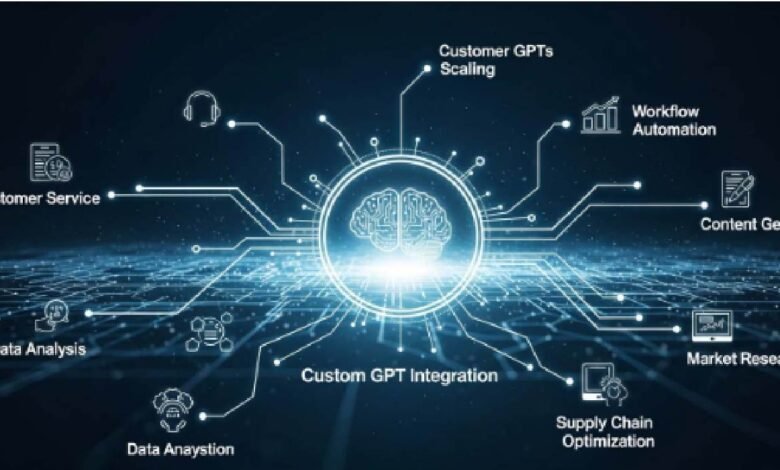
Custom GPT Integration is transforming the way US businesses operate by introducing intelligent automation, smarter workflows, and scalable AI-powered solutions. As industries demand more efficient processes and personalized customer interactions, many organizations are now embracing AI and GPT integration to modernize their operations and stay competitive.
What Is Custom GPT Integration?
Custom GPT Integration refers to embedding advanced GPT models directly into business systems, workflows, and digital products. Unlike off-the-shelf tools, these integrations are tailored to a company’s internal data, processes, and user needs.
How GPT Models Integrate into Business Systems
- Via APIs
- Through internal dashboards
- Connected with CRM, ERP, and support platforms
- Using secure, custom data pipelines
Standard GPT Tools vs. Custom Solutions
| Standard GPT Tools | Custom GPT Integration |
| One-size-fits-all | Tailor-made for business workflows |
| Limited to generic responses | Uses internal data for accuracy |
| Minimal automation | Full workflow automation |
| Good for individuals | Designed for scaling companies |
Why US Businesses Are Rapidly Adopting GPT
- Rising labor costs
- Rapid demand for automation
- Competition for faster customer service
- Need for AI-driven insights
How Custom GPT Integration Works in Real Business Environments
API Integration
Developers connect GPT models to internal systems to automate tasks like processing emails, generating reports, or handling customer queries.
Workflow Automation
GPT agents automate daily operations such as:
- Responding to support tickets
- Scheduling
- Data entry
- document generation
Data Processing & Knowledge Bases
Custom GPT systems can ingest internal data to provide precise, company-specific answers.
Custom Chatbots & AI Assistants
Businesses use GPT-powered assistants for:
- Customer support
- Sales qualification
- HR onboarding
- Technical troubleshooting
Benefits of Custom GPT Integration for US Companies
Cost Reduction & Efficiency
AI handles repetitive work instantly, reducing manual load and labor expenses.
Enhanced Customer Experience
Faster replies, personalized responses, and 24/7 availability improve satisfaction and retention.
Automation of Repetitive Tasks
From summarizing documents to generating contracts, GPT drastically reduces operational timelines.
Smarter Decision-Making
AI analyzes internal data to provide insights, recommendations, and forecasting.
Practical Use Cases Across US Industries
E-Commerce
GPT automates customer support, search recommendations, and product descriptions.
Finance
Automated compliance summaries, risk assessments, data extraction, and client communication.
Real Estate
Lead qualification bots and automated property descriptions.
Healthcare
Patient FAQ chatbots, appointment scheduling, and record summarization.
SaaS & Tech
In-app AI assistants, documentation generators, and onboarding automation.
How US Businesses Choose the Right GPT Integration Provider
Key Features to Look For
- Strong AI/ML engineering background
- Experience with automation workflows
- Ability to build custom GPT agents
- Secure data handling
Technical Expertise
A strong provider should support:
- API integrations
- Vector databases
- Data pipelines
- Fine-tuning or RAG (Retrieval-Augmented Generation)
Pricing Models
Options include:
- Project-based
- Monthly retainer
- Enterprise licensing
Security & Compliance
Vital for sectors like healthcare, finance, and legal.
Challenges in GPT Integration (and How to Solve Them)
Data Accuracy
Use structured datasets and regular fine-tuning.
System Compatibility
APIs bridge gaps between old systems and new AI layers.
Over-Automation Risks
Human verification should remain part of high-impact workflows.
Ethical AI Use
Maintain transparency, fairness, and responsible AI deployment.
The Future of Custom GPT Integration in the US Market
Autonomous Workflows
End-to-end automated systems that operate with minimal human involvement.
Industry-Specific Micro-AI Models
Niche GPTs trained for medical, legal, education, or engineering use.
Enhanced Customer Experience Engines
Predictive messaging, smart routing, and real-time personalization.
New Business Models Enabled by AI
AI-as-a-service offerings, autonomous support teams, and self-operating digital tools.
Why Custom GPT Integration Is Now Essential for Scaling
Custom GPT Integration has become a growth accelerator for US businesses. By automating operations, enhancing customer experiences, and enabling smarter decision-making, companies can scale faster than ever before. Whether you’re building advanced workflows or looking to incorporate intelligent AI agents, partnering with a capable integration provider is the key to unlocking long-term success.
For organizations seeking reliable, future-ready GPT solutions, Mindrind stands out as a strong partner that helps businesses accelerate innovation with advanced AI capabilities.
FAQs:
1. What is Custom GPT Integration?
Custom GPT Integration refers to embedding GPT models directly into business workflows, software, or data systems to automate tasks, enhance customer experiences, and improve operational efficiency.
2. How does GPT integration benefit US businesses?
It reduces manual workload, accelerates customer support, automates repetitive tasks, and provides data-driven insights—ultimately helping companies scale faster and more cost-effectively.
3. What is GPT automation for business?
GPT automation for business is the use of AI models to streamline processes like email handling, report generation, content creation, support ticket management, and workflow automation.
4. Which industries benefit most from GPT integration?
Industries like e-commerce, healthcare, finance, SaaS, education, and real estate see immediate benefits from automation, enhanced communication, and AI-assisted decision-making.
5. How complicated is it to integrate GPT into an existing system?
Complexity varies. Simple chatbot integrations are easy, while advanced workflows like CRM or ERP connections require experienced AI engineers and secure data pipelines.
6. Can GPT be trained on a company’s internal data?
Yes. GPT can be connected to private knowledge bases or trained through Retrieval-Augmented Generation (RAG) to deliver accurate, company-specific responses.
7. Is Custom GPT Integration secure?
When implemented correctly with encryption, access controls, and compliance checks, GPT integration can be highly secure. Choosing a responsible provider is essential.
8. How do I choose a GPT integration provider?
Look for expertise in AI engineering, workflow automation, data security, and enterprise system integration. The provider should also offer scalable solutions and reliable support.