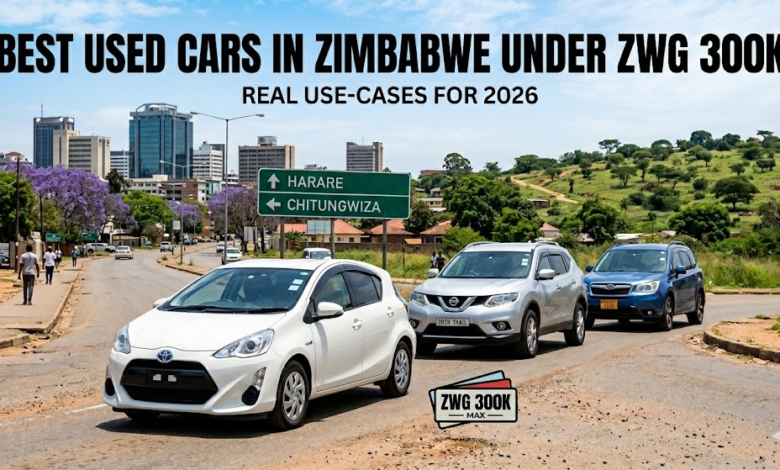
Buying a used car in Zimbabwe is a major milestone, but it often comes with a “Harare headache.” You see a shiny price on a Japanese auction site, fall in love with the photos, and then the reality hits: clearing costs, border paperwork, inland transport, and the nagging fear that the car won’t survive the first rainy season on Samora Machel Avenue or the rougher stretches heading out toward Chitungwiza and beyond.
If you have a budget of ZWG 300K, you are in the “sweet spot.” This is the most practical budget band in Zimbabwe, high enough to afford a reliable, modern Japanese import, but low enough that you need to be strategic. The reality? Two cars can look identical on screen, but their actual “mkononi” (landed) condition, battery health, and maintenance history will dictate whether you’ve bought a dream or a mechanical nightmare.
In this guide, we aren’t just listing popular cars. We are picking the best vehicles based on how you actually live and work in Zimbabwe, from the stop-and-go traffic of Harare CBD to the longer, tougher drives toward Bulawayo, Mutare, and the rural routes where road conditions can change fast.
The Budget Reality Check: ZWG 300K in the Real World
Before we dive into the models, let’s clear up the biggest source of confusion: The Price Gap.
Most international listings are in USD, while your savings are in ZWG. As of February 2026, ZWG 300,000 is roughly equivalent to a mid-range used-import budget in USD terms, but the exact figure depends heavily on the rate you are using on that day. However, the “Sale Price” you see online is only about 50-60% of what you will actually pay.
How to think about your ZWG 300K budget:
Sale Price (FOB): The actual cost of the car in Japan.
- Shipping & Port Charges: Getting it to Durban or Walvis Bay.
- Taxes (Ushuru): Duties and taxes that apply on import, plus clearance and transit costs that stack depending on vehicle details.
- Registration & Buffer: Plates, registration, and your first “welcome home” service (new tyres/battery).
Pro Tip: If a car has a sale price of $8,000, its final landed price after shipping, clearance, and transit to Zimbabwe can climb fast and sit close to your total budget. Always ask for a “Total Landed Cost” estimate before committing.
Our Selection Criteria
We didn’t pick these cars based on hype. We chose them because they pass the Zimbabwean Stress Test:
- Parts Availability: Can your mechanic in Willowvale find a spare part without a two-week wait?
- Fuel Efficiency: Can you survive Harare traffic and long-distance runs without your wallet crying?
- Ground Clearance: Will it survive potholes, speed bumps, and rainy season damage?
- Resale Value: When you’re ready to upgrade, will people actually want to buy it?
Quick Picks: Best Cars for Harare (2026)
| Model + Year | Why It’s a Winner | Best Use-Case |
| 2019 Toyota Aqua Hybrid | Fuel king; legendary reliability. | Daily Harare Commute |
| 2023 Nissan Serena Petrol | Massive space; modern tech; 7-8 seater. | Large Families / Shuttle |
| 2018 Nissan X-Trail | SUV stability; professional looks. | Upcountry / Mixed Roads |
| 2020 Nissan Kicks Hybrid | Modern crossover; high efficiency. | Young Professionals |
| 2015 Subaru Forester | AWD confidence; rugged build. | Long Distance / Rough Terrain |
The City Fuel Saver: 2019 Toyota Aqua Hybrid (NHP10)
Price Estimate: ~$7,950 Sale Price (~ZWG 317,700 to ZWG 381,300 Landed)
If your life revolves around the Harare commute, spending two hours moving a few kilometres between Town and Borrowdale, the Aqua is your best friend. This car is purpose-built for office workers, students, and first-time buyers who want a modern vehicle that costs less to run than a daily ride-hailing habit. Its primary strength lies in the refined 1.5L 1NZ-FXE hybrid engine, which comfortably achieves strong fuel economy in real city driving. In stop-start traffic, the Aqua sits in “EV Mode,” meaning you aren’t burning a single drop of petrol while idling in the midday heat. While Toyota’s hybrid system is now common across Southern Africa with plenty of spare parts available through import networks, always ask for a Battery Health Report. Ensure the cooling vent under the rear seat is dust-free to prevent cells from overheating in Zimbabwe heat. For those needing something even more compact, the 2019 Toyota Vitz Hybrid offers a similar efficiency vibe and legendary Toyota resale strength.
The Family Powerhouse: 2023 Nissan Serena (C28)
Price Estimate: ~$14,350 Sale Price (~ZWG 300,000+ Landed)
The Serena C28 is a “game changer” for large households and “School Run Heroes.” While a 2023 Toyota Noah might still be out of reach at this price, the Serena offers a futuristic aesthetic and features that feel like a luxury lounge. It is the ultimate choice for families with 3+ children or those who often travel with extended relatives to Marondera, Norton, or the rural home. The interior features a full digital dashboard and water-repellent seats that comfortably accommodate 8 people. Families love the smart tailgate design because it makes loading easier in tight parking at malls and school gates. When buying, be sure to test the Auto-Sliding Door sensors and ensure the rear AC blowers are pushing strong, cold air for the third row. As an alternative, the 2014 Toyota Voxy Hybrid remains a smart value family mover, offering massive interior space and superior economy for long daily distances.
The Biashara / Workhorse: 2018 Nissan X-Trail (NT32)
Price Estimate: ~$11,650 Sale Price (~ZWG 496,900 to ZWG 596,200 Landed)
Need a car that looks professional for a meeting in the city but can also carry supplies to a site or a business run out of town? The X-Trail is the ultimate multi-tasker for managers, entrepreneurs, and anyone who needs a strong all-rounder. It commands respect as a “prestige” SUV without the heavy maintenance costs of bigger off-road trucks. It features Active Ride Control, a clever tech that automatically applies subtle braking when you hit a bump, preventing that “bouncing” feel common on rough roads. For business use, the 2WD model is lighter and more fuel-efficient for city driving, while the 4WD is essential if your work takes you to muddy sites or rural roads after rain. A critical check for this vehicle is the CVT Transmission; ensure the fluid has been changed recently, as a well-maintained Nissan CVT should be smooth as silk. The X-Trail is perfect for those who need a professional “Boss” look by day and a cargo-carrying workhorse by night.
The Upcountry Traveler: 2015 Subaru Forester (SJ)
Price Estimate: ~$7,450 Sale Price (~ ZWG 317,700 to ZWG 381,300 Landed)
If your job involves high-mileage driving between Harare, Mutare, and Bulawayo, you need the stability of a Subaru. The Forester is designed for adventure seekers and high-mileage drivers who prioritize grip and safety over flashy gadgets. Unlike other SUVs, Subaru’s Symmetrical AWD is always engaged, providing constant grip on wet, muddy, or sandy roads. With 220mm of ground clearance, it clears deep ruts and potholes that would leave a sedan stranded. Most 2015 models include the EyeSight Driver Assist system, which uses dual cameras for pre-collision braking, a real safety advantage on long, fatiguing highway drives. Before purchasing, verify the service history, as Subarus are sensitive to oil quality; ensure there are no signs of head gasket leaks and that only high-quality synthetic oils have been used. It remains the “mountain goat” of the ZWG 300,000 budget, perfect for those who live for the weekend and rugged terrain.
Common Buyer Mistakes in the ZWG 300K Range
Ignoring the “Age Penalty”: A cheaper older model can end up costing more once you add the real taxes, clearance costs, and the first wave of repairs.
Buying the “Lowest Price” Unit: In the ZWG 300,000 range, a car that is $2,000 cheaper than the rest usually has a hidden reason (accident history, high mileage, or a dying hybrid battery).
The “Wrong Job” Trap: Don’t buy a tiny hatchback if you have 4 kids and you do rough-road driving often. You’ll spend your “fuel savings” on suspension repairs every few months.
What to Verify Before You Pay
Before you wire any money to Japan or a local dealer:
- The Auction Sheet: This is the car’s “report card.” Look for grades 4 or higher.
- Detailed Photos: Look at the underbody for rust (especially if the car came from northern Japan).
- Chassis Number: Cross-reference it with the paperwork to ensure the year of manufacture is correct.
Why Buy Through Carbarn Zimbabwe?
Buying a car in the ZWG 300K range shouldn’t feel like a high-stakes gamble. At Carbarn Zimbabwe, we’ve replaced typical sales talk with a platform built on radical transparency and data-backed trust. We eliminate the “Harare headache” of hidden fees. Our True Cost Breakdown calculates your exact “mkononi” (landed) price upfront, incorporating shipping, port charges, and clearance costs, so there are zero surprises when your car arrives. We use Durban and Walvis Bay routes for Zimbabwe depending on the best schedule and flow, and from the moment you select a vehicle that fits your lifestyle, whether it’s a fuel-sipping Toyota Aqua for the city or a rugged Nissan X-Trail for upcountry roads, we provide End-to-End Support, managing everything from maritime tracking to final coordination so you can plan your clearing smoothly. The best car under ZWG 300,000 is the one that fits your life perfectly. At Carbarn, we ensure you find it, import it, and drive it with total confidence.