ROI of Investing in a Benchtop Hardness Tester for Small and Medium Industries in the USA

Introduction
In the modern world of competitive manufacturing, small and medium-sized industries in the United States feel the constant pressure of providing consistent quality while ensuring operational expenses are under control. A benchtop hardness tester in the USA is one such solution that continues to prove its value.
For small and medium industries in the USA, quality control is not a luxury. It is a competitive necessity. This blog breaks down the measurable return on investment of deploying a benchtop hardness tester in the USA, covering cost savings, compliance advantages, and the right models for your operation.
Why Hardness Testing Matters for SMEs
Hardness testing is very important in identifying the strength, wear and longevity of materials. In the case of the industries that handle metals and alloys, any slight fluctuations would lead to product failures, rework or customers being unhappy.
A benchtop hardness testing machine will allow manufacturers to make quick and precise tests directly on-site. This reduces the reliance on third-party labs, minimizes turnaround time and provides better control over production quality.
Heat treatment variability and machining stress can alter the hardness profile of a component significantly even within the same lot. Without in-house verification using a benchtop hardness tester machine, a non-conforming component can travel through several production stages before the failure is caught.
NIST’s Manufacturing Cost Guide puts the scale of this problem in perspective, estimating that defects cost U.S. discrete manufacturers between $32 billion and $58.6 billion every year. By then the scraps, rework time and delivery fines are way beyond what a dedicated testing device would have cost.
Direct ROI Drivers
When evaluating ROI, businesses often focus only on upfront investment. But the actual value of a benchtop hardness tester in the USA is in its operational benefits in the long run.
- Elimination of Third-Party Testing Fees
External hardness testing services charge per sample or per batch. For an SME running multiple material grades per week, these fees accumulate fast. Bringing testing in-house eliminates this recurring cost entirely.
- Increased Productivity
Production teams can quickly validate materials and processes when they have immediate access to testing. This reduces time wastage and keeps the operations going smoothly.
- Lower Rejection and Rework Rates
Accurate Measurement of the hardness of the material will ensure that only the materials that are compliant go to the next stage so there is less wastage and costly rework
- Enhanced Quality Assurance
Frequent testing creates credibility among customers and helps in maintaining the high standards of quality that are needed in the B2B environment.
Types of Benchtop Hardness Testers and Their Applications
Modern hardness testing systems are designed to satisfy numerous industrial needs. According to the material and usage, businesses can select from the different methods of testing given below:
1: Rockwell Testing
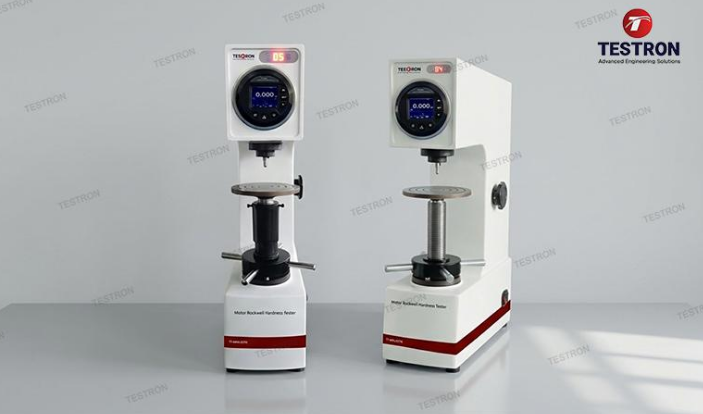
A benchtop Rockwell hardness tester is commonly used for quick and direct hardness measurements. It is suitable in the production settings where speed and efficiency are crucial.
2: Brinell Testing
A Benchtop Brinell hardness Tester is a tool used to test coarse-structure materials such as castings and forgings. It gives reliable results when dealing with heavier components.
3: Vickers Testing
Vickers testing is very precise and is frequently applied to materials with thin coatings, where precision is highly important.
Popular Models and Their Applications
1: TTBRV-187.5E Electric Universal Hardness Tester combines benchtop Rockwell hardness tester capability with Brinell and Vickers methods in a single instrument. The electric drive ensures consistent load application with digital data output, making it the most versatile option for SMEs working across varied materials.
2: TT-B3000C Digital Brinell Hardness Tester is built for castings, forgings, and structural steel. This Benchtop Brinell hardness Tester uses closed-loop load cell technology for repeatable indentation force and precise optical measurement, particularly suited to foundries and heavy fabricators.
3: TT-VK1000A Digital Micro Knoop/Vickers Tester is the instrument of choice for precision manufacturing, providing microhardness measurements on thin foils, case-hardened layers, and small components with virtually no surface marking.
4: TTBRV-187.5D Digital Universal Hardness Tester delivers enhanced digital readout precision for quality labs performing mixed-method testing across varied component types.
Each of these qualifies as the best benchtop hardness tester configuration when matched correctly to application requirements.
Understanding Benchtop Hardness Tester Cost vs. Value
The benchtop hardness tester price varies based on testing method, load range, and automation level. If a facility spends more annually on external testing fees and scrap costs than the purchase price of a mid-range instrument, the payback period is typically under twelve months. For most SMEs in metal fabrication or automotive supply, that threshold is crossed readily.
Ongoing calibration, typically every six to twelve months, remains a modest cost relative to the operational value delivered. A reliable benchtop hardness tester manufacturer will always provide the best operational value in the long run.
Choosing the right benchtop hardness tester supplier is also important as you get technical support, calibration and spare parts, all of which are necessary factors influencing the benchtop hardness tester cost.
How SMEs Can Maximise ROI
To properly understand the benefits of a benchtop hardness tester in the USA, businesses should focus on appropriate applications and implementation.
- Optimize Testing Processes:Make hardness testing a part of the regular quality tests and not a separate process.
- Train Operators:Professionally trained teams will definitely provide accurate results and reduce the risk of errors.
- Keep Equipment in Good Condition:Routine servicing and regular calibration can help keep the results accurate and boost the life of metal testing equipment.
These practices would allow SMEs to ensure that their investment continues to provide value in the long run.
Conclusion
For SMEs operating in the USA’s competitive manufacturing landscape, a benchtop hardness tester in the USA delivers measurable returns through reduced scrap, eliminated third-party testing costs, faster cycle times, and stronger compliance posture.
To find the right configuration for your facility, contact Testron Group today or request a demo.